Welcome back to this blog! I hope you had a great spring break, and for those who did not have a spring break, I hope you've been having a great life! Let me tell you, adjusting back to my work at Liberty Wildlife was time-consuming. I had to read all my documents and notes over again to remember what I wanted to work on, and then I also had less time for research because I was helping around the site more, so this whole week is pretty much a big blob of blurriness. That being said, I'll try to make this post interesting, but I'm not sure how much I can actually report on about my research.

So, for starters, if you remember from last week (or the week before last week), I talked about general behavior in wild American Kestrels. One thing I said was how kestrels go back to the same nesting site every year, which I thought was really cool (obviously there is something very important about the nesting site then, so keep that in mind when I bring up my next point). It's known that the kestrels are now a "human-tolerant" species, which means they've become more comfortable living in urban areas around humans, and have adapted to meet all their necessities in these environments. However, recent studies have been done that show kestrels living specifically in urban areas are abandoning their nests.
A link to one study is here: http://onlinelibrary.wiley.com/doi/10.1111/1365-2664.12103/full
A fun statistic:
36% of kestrel nesting attempts failed and 88% of failures occurred during incubation. Kestrels nesting in higher disturbance areas were 9.9 times more likely to fail than kestrels nesting in lower disturbance areas. Habitat and clutch initiation date did not explain reproductive outcome.
(Also, side note: my laptop was "confiscated" by the Geek Squad because I foolishly unconsciously decided I wanted to see what would happen if I spilled water on my keyboard (answer: nothing good), so I lost all my bookmarks and downloads that I saved for this project....so I'm sorry. I'm using an old laptop right now, but I'll be getting the one that actually has things on it back in about two weeks.)
Okay, back to other things. So, kestrels are abandoning their nests when they should not be doing that. Why? Well, this is something that I do plan to go further into. One of the spectacular things about animal behavior is that most things are never known for sure. It's a lot of logical analysis with some speculation and much observation, but we can't really go up to the animal and ask them, "Why do you do what you do?" so we're stuck with what we got. So, you know, that's unfortunate, but oh well. My hypothesis for now is that this new change has something to do with their finicky diet (so they either might be hunting someplace far from the nest to get the food they need or they could be actually getting hurt from the diet they are forced to have in the city) or (and especially in Arizona) the kestrels might be abandoning the nests in the city because it gets too hot and kestrels (though they can live in the desert) have their limits just like us.

Yeah, so expect that one day. Goodness, I can't believe it's already Week 6. We've reached and crossed the halfway point, and there is no looking back. I miss things already. No, enough sadness, let's talk about my week, because everyone wants to hear about that!
So basically we got some new animals this week. For some weird reason, there was a huge influx in hummingbirds this week, so I don't know what going on with those guys out there, but it seems they need some assistance with their lives. Here's some pictures of the hummingbirds and a hatchling hummingbird:

 |
| This little guy's head is up to show that it's hungry Also, they're supposed to look like that. Don't worry. |
We also got a juvenile owl brought in and it was super fluffy, so that was tons of fun.
 |
| CC: Pieter Mead Fun Fact: Apparently, he also went to BASIS Scottsdale in middle school, so random coincidences there. |

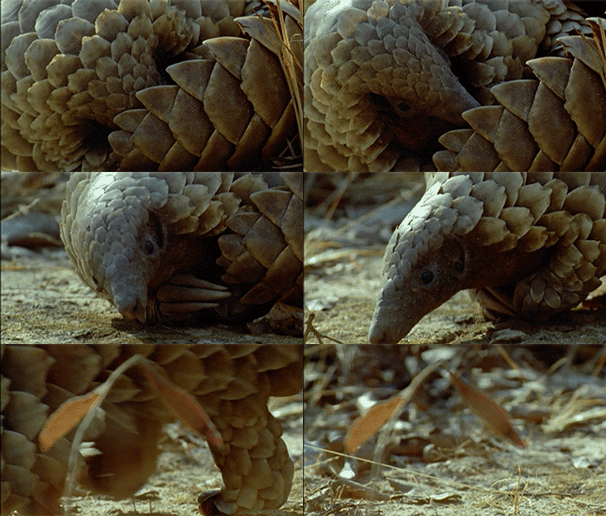
This animal is absolutely adorable. And it's the only mammal covered in scales (fun fact #1) .
2) The scales are made of keratin, just like our finger nails, and make up 20 per cent of their body weight.
3) The mammal can consume up to 20,000 ants a day.
4) Pangolins can close their ears and nostrils using strong muscles. This helps protect them from ant attacks.
5) They have long, sticky tongues, which are often longer than their body and attached near its pelvis and last pair of ribs. If a pangolin fully extends its tongue, it is longer than the animal’s head and body! I mean, I can't even touch my nose with my tongue, so this is pretty impressive for me.
6) Pangolins don't have teeth, so they can’t chew. Instead, they have keratinous spines in their stomach and swallow stones that help them grind up their food in much the same manner as a bird’s gizzard.
(Brought to you by "9 Amazing Pangolin Facts" on Wildlife WorldWide)
There ya go!! A bunch of stuff to keep you satisfied for the week. I hope you enjoyed my post, but if you didn't, I apologize greatly and I'll do better next time. For now, have a nice life, and here's some bad advice that you should not take seriously please (I can't afford to buy you a new phone):
 |
| Magnify your phone's screen by putting it in a glass of water! |